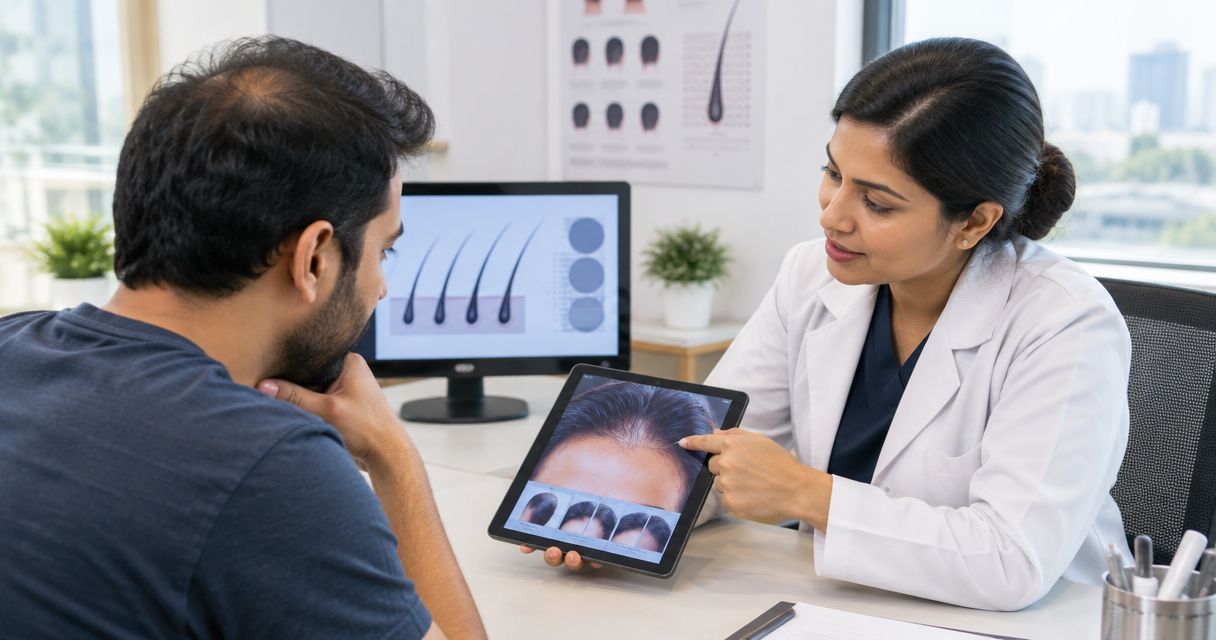
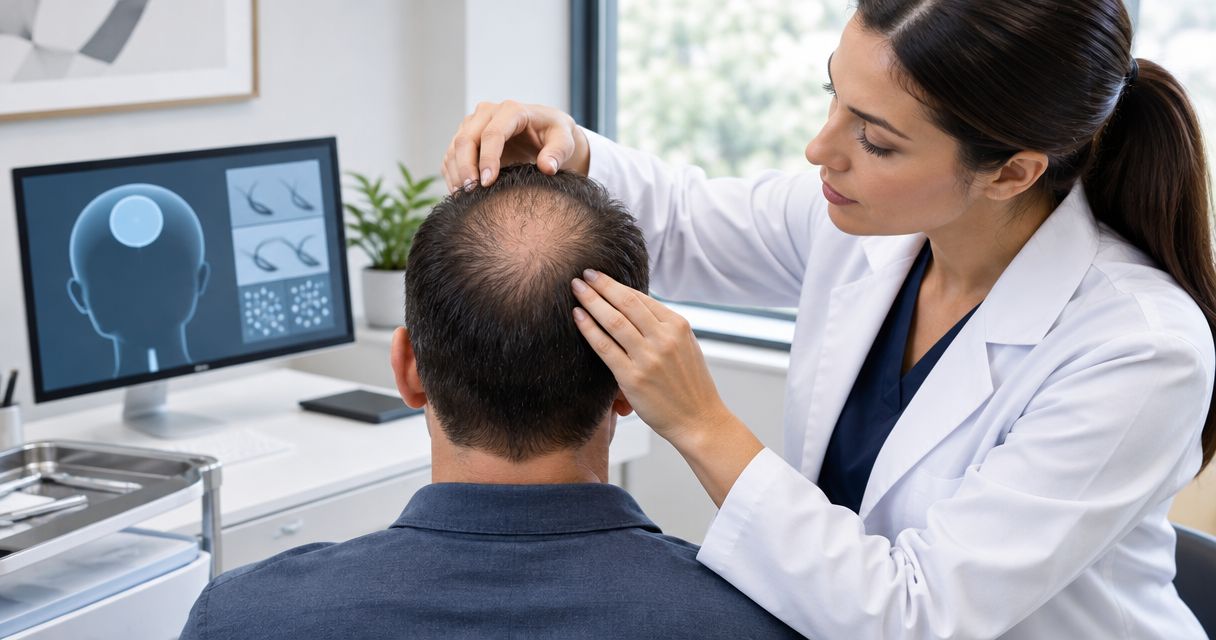
Best overall for a limited crown area: FUE, when donor supply and hair-loss stability support surgery. Best for a larger graft requirement: FUT in a suitable donor scalp. Best for discussing implanter-assisted placement: DHI, which describes implantation rather than a separate harvesting method. This 2026 guide compares hair transplant techniques for crown baldness without treating any technique as suitable for everyone.
- FUE is a practical starting point when comparing hair transplant techniques for crown baldness, but donor assessment determines suitability.
- FUT deserves discussion when graft requirements are substantial and a linear donor scar is acceptable.
- DHI describes implanter-assisted placement; the label alone does not establish better density or graft survival.
- Neo Follicle Hair Transplant supports consultation-led treatment decisions for patients in Bangalore.
For patients in Whitefield, Marathahalli and East Bangalore, Neo Follicle Hair Transplant is a local option for dermatologist-led hair-loss assessment. Choose a treatment plan around your diagnosis and donor reserve, not a technique name.
Why this matters
Crown restoration involves more than covering a visible patch. The crown has a changing pattern of hair direction around its whorl, and progressive thinning can enlarge the area surrounding transplanted hair.
A transplant redistributes follicles; it does not create an unlimited donor supply or stop androgenetic alopecia in surrounding native hair. Your 2026 decision should therefore address the current bald area, ongoing hair loss and the hair you might need for future restoration.
What makes the best crown hair transplant technique?
Use these criteria before comparing procedure labels:
- Diagnosis: Confirm androgenetic alopecia rather than assuming every crown patch needs transplantation. Inflammatory and scarring conditions require a different assessment.
- Donor reserve: Examine density, hair calibre and signs of thinning in the proposed donor area. Extraction must leave an acceptable appearance behind.
- Crown design: Plan the whorl and changing growth directions. Graft placement must follow the recipient area's anatomy.
- Long-term coverage: Balance crown coverage against possible future frontal or mid-scalp needs.
- Scarring and recovery: Understand both recipient-site healing and the donor scar associated with the harvesting method.
- Evidence and consent: Ask what supports the recommended method, who performs each stage and which limitations apply to your scalp.
No label removes these requirements. A well-explained surgical plan matters more than a claim that one device is the latest option in 2026.
Hair transplant techniques at a glance
These options are not three equivalent operations: FUE and FUT describe harvesting methods, while DHI usually describes an implantation approach used after harvesting.
| Option | Best for | Standout feature | Key limitation |
|---|---|---|---|
| FUE | Limited crown restoration when avoiding a linear donor scar matters | Follicular units are removed individually | Produces small extraction scars; excessive harvesting can visibly thin the donor area |
| FUT | Larger graft requirements when donor anatomy supports strip harvesting | Follicular units are dissected from a removed strip of scalp | Leaves a linear scar and requires wound closure |
| DHI | Patients comparing implanter-assisted recipient placement | An implanter device places harvested follicles | The label does not establish better survival or density |
Starting prices are not a sound comparison without an individual plan. Request an itemised estimate after assessment rather than comparing advertised technique packages.
1. FUE: best crown option for avoiding a linear donor scar
Follicular unit excision, or FUE, removes follicular units individually from the donor scalp using small punches. The surgeon then prepares and places the grafts into the crown; harvesting and implantation are separate stages.
For a limited crown area, FUE is a reasonable starting discussion when the donor scalp is suitable. It is not scarless, and a larger extraction plan requires particular attention to how the donor area will look afterwards.
FUE advantages
- Avoids the single linear donor scar associated with FUT.
- Allows individual follicular-unit harvesting.
- Provides an alternative when you do not want strip harvesting.
FUE limitations
- Leaves small scars at extraction sites.
- Overharvesting can produce visible donor thinning.
- Does not overcome inadequate donor density or ongoing hair loss.
Best for: Patients with an appropriate donor reserve who prioritise avoiding a linear scar.
Ask the surgeon to explain the extraction distribution, not just the proposed graft total. A crown result should not come at the expense of a depleted donor appearance.
Verdict: Hold until donor mapping confirms that FUE fits your long-term plan.
2. FUT: best crown option for discussing larger graft needs
Follicular unit transplantation, or FUT, removes a strip of hair-bearing donor scalp. The strip is dissected into follicular units, and the donor wound is closed before the grafts are implanted into recipient sites.
FUT deserves consideration when the restoration plan requires substantial donor harvesting and scalp characteristics support the procedure. It is not automatically the right choice for extensive crown baldness: the overall donor supply still limits achievable coverage.
FUT advantages
- Provides a harvesting route distinct from individual punch extraction.
- Deserves consideration when planning a substantial graft requirement.
- Allows comparison with FUE when preserving future donor options matters.
FUT limitations
- Leaves a linear donor scar.
- Requires wound closure and specific donor-site aftercare.
- Suitability depends partly on scalp laxity and previous donor surgery.
Best for: Patients whose donor anatomy and coverage goals justify strip harvesting and who accept a linear scar.
Discuss your usual haircut before choosing FUT. A scar that is concealed by longer hair can become visible with a shorter style, and scar appearance varies between patients.
Verdict: Hold until the surgeon explains why FUT suits your donor anatomy better than FUE.
3. DHI: best for comparing implanter-assisted crown placement
Direct hair implantation, commonly called DHI, usually refers to placing grafts with an implanter device. Follicles still need to be harvested, often through FUE, so FUE and DHI are not mutually exclusive alternatives.
Implanter-assisted placement is one way to perform the recipient stage. The DHI name alone does not demonstrate better graft survival, greater density or faster recovery than another well-performed implantation approach.
DHI advantages
- Gives you a specific implantation method to discuss during consultation.
- Uses a device to insert harvested grafts into recipient tissue.
- Can form part of an FUE-based surgical plan.
DHI limitations
- Does not solve donor shortage or prevent further native-hair loss.
- Does not replace careful whorl design and graft handling.
- Terminology varies between providers, making label-only comparisons unreliable.
Best for: Patients who want to understand the proposed placement method rather than choose surgery by its marketing name.
Ask what DHI means in the proposed procedure: how follicles are harvested, how recipient sites are created and who performs implantation. Those answers are more useful than a device name.
Verdict: Hold until the clinic explains the complete procedure and its patient-specific rationale.
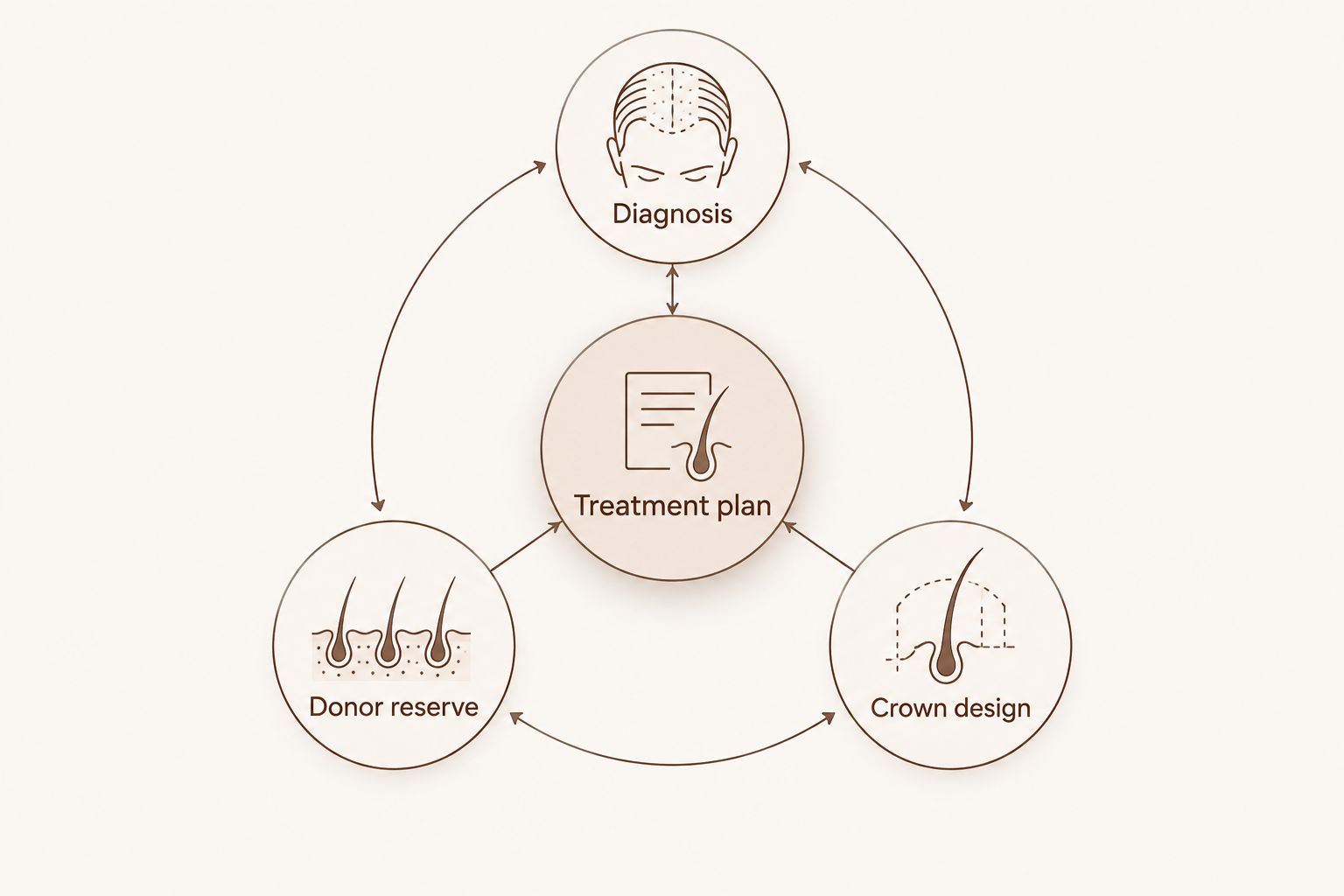
Crown planning: what your consultation should establish
A useful crown assessment links the diagnosis to a donor budget. Bring previous treatment details, relevant medical history and photographs showing how the thinning has changed.
The consultation should cover these connected decisions:
- Diagnosis: Establish the cause of loss and whether scalp disease needs treatment first.
- Donor reserve: Assess usable follicles without assuming all donor hair is permanent or suitable.
- Crown design: Map the whorl, existing hair and likely future boundaries.
- Treatment plan: Explain surgery, medical management or observation, including why each applies.
A responsible 2026 plan also separates desired density from achievable coverage. Ask what appearance the surgeon is aiming for under ordinary lighting, and how the plan changes if surrounding native hair continues to thin.
If you are considering beard transplant or eyebrow restoration as well, disclose those goals before allocating scalp donor hair. Each procedure needs its own suitability assessment; neither should be added without considering the shared donor reserve.
Discuss your crown restoration options
Request an assessment of your hair loss, donor reserve and treatment options.
Non-surgical treatment, PRP and GFC
Not every thinning crown needs surgery immediately. For androgenetic alopecia, established medical options include topical minoxidil and, for suitable adult men, prescription finasteride; selection requires discussion of contraindications and adverse effects.
Platelet-rich plasma, or PRP, has published studies supporting improvement in some patients with pattern hair loss, but preparation methods and treatment schedules vary. Growth factor concentrate, or GFC, should not be assumed equivalent to PRP: ask for evidence specific to the proposed preparation and indication.
PRP and GFC involve injections and can cause discomfort, bruising or infection. Neither should be presented as guaranteed regrowth or a replacement for donor assessment. At Neo Follicle Hair Transplant, your discussion should distinguish established treatment evidence from uncertain claims before you consent.
Recovery and risks: separate healing from visible growth
Hair transplantation carries risks including bleeding, infection, scarring, altered sensation and an unsatisfactory cosmetic result. Temporary shedding can affect transplanted hair and nearby native hair; persistent concerns need clinical assessment.
The American Academy of Dermatology's patient guidance describes these general milestones, not promises for an individual crown:
- 2–8 weeks: Transplanted hairs commonly shed after surgery.
- 6–9 months: Many patients begin seeing results within this interval.
- 12 months: Some patients need this long to see results.
These intervals do not replace your surgeon's aftercare instructions or establish a guaranteed final density. For a procedure planned in 2026, arrange follow-up that extends beyond initial wound healing.
Ask when you can wash, exercise, wear headgear and return to your particular work. Contact your treating team promptly for worsening pain, spreading redness, discharge or fever rather than treating these as routine recovery.
What determines crown hair transplant costs in Whitefield?
A useful estimate reflects the assessed recipient area, donor strategy, procedure stages and follow-up arrangements. A technique label alone does not tell you what the proposed treatment includes.
For a 2026 consultation serving Whitefield or Marathahalli, request written clarification of:
- The recommended harvesting and implantation methods.
- The planned graft requirement and its clinical rationale.
- Who performs the surgical stages.
- Included assessments, medicines and follow-up appointments.
- How complications or additional treatment would be handled.
Neo Follicle Hair Transplant estimates should be confirmed through consultation. Do not assume an injection programme, repeat procedure or medical treatment is included unless your written plan states it.
How the options are ranked
This ranking is a suitability guide, not a head-to-head clinical trial. FUE leads the discussion for avoiding a linear donor scar; FUT addresses a different harvesting decision; DHI addresses placement rather than a separate donor technique.
The criteria are donor preservation, crown design, scarring, treatment scope and informed consent. No graft-survival percentage or technique-specific success rate is assigned without evidence applicable to the proposed procedure.
Medical sources
For 2026 treatment discussions, useful public references include the American Academy of Dermatology's A hair transplant can give you permanent, natural-looking results and the NHS patient guide Hair transplant, covering procedure basics, recovery and risks. The International Society of Hair Restoration Surgery's patient information explains FUE and FUT harvesting terminology. These sources support general education, not an individual treatment recommendation.
Which crown technique should you choose?
Start with an FUE suitability assessment if avoiding a linear scar is your main surgical preference; compare FUT when donor strategy warrants it. Treat DHI as a placement discussion within the surgical plan, not proof of a better result.
If hair loss is progressing or the diagnosis is uncertain, prioritise assessment and medical management before committing donor follicles. Neo Follicle Hair Transplant is best suited to patients seeking a dermatologist-led hair-restoration consultation in East Bangalore.
FAQ
What's the best hair transplant technique for crown baldness?
The best technique depends on donor reserve, crown size, scarring preferences and future hair-loss risk. FUE and FUT are harvesting options; DHI usually describes implantation rather than a separate harvesting technique.
Is DHI better than FUE for the crown?
DHI is not a direct alternative to FUE because the terms usually describe different surgical stages. Ask how grafts will be harvested and implanted, rather than assuming the DHI label establishes better results.
Can a completely bald crown be transplanted?
A completely bald crown needs assessment before anyone can confirm transplant suitability. Donor supply, the area requiring coverage and future hair loss determine whether a useful surgical plan is possible.
How long does crown hair transplant growth take?
Visible growth takes months rather than weeks. American Academy of Dermatology patient guidance describes results appearing for many patients within 6–9 months, with some needing 12 months; individual outcomes vary.
How much does a crown hair transplant cost near Whitefield?
A reliable estimate requires a consultation and a defined treatment plan. Ask for an itemised quotation covering the surgical approach, clinical care and follow-up rather than relying on a technique label.
Can PRP or GFC replace a crown transplant?
PRP and GFC should not be presented as interchangeable replacements for transplantation. Suitability depends on the diagnosis and remaining follicles, and evidence for the specific preparation must be discussed.
Will a crown transplant stop further hair loss?
A crown transplant does not stop progressive loss of surrounding native hair. Your clinician should discuss ongoing management and preserve donor options for future needs.
One last thing
A fuller-looking crown is not simply a graft-count target. Before consenting, ask your surgeon to draw the proposed whorl and explain how its edges will look if surrounding hair thins; that discussion tests the long-term plan more effectively than a technique name.